Dystopia

Next week, our students begin

a dystopian book unit —

tales of a world gone awry,

government control,

and teen protagonists challenging power.

Today, Russia violently invades Ukraine,

Australian towns are underwater,

fire ravages the west,

cities in Africa thirst for drinking water,

books are banned and burned,

some young people destroy

school property

at the command of a social media platform.

There is hope,

students calling on everyone

to wear yellow and blue for Ukraine,

Greta Thunberg and others

speaking up for the planet,

voices of children

crying out against gun violence.

I wonder if my student’s new book unit

should instead be called non-fiction?

Offering

When my grandmother died,

we marveled to find notes

tucked in jewelry boxes,

coat pockets,

beaded handbags and books.

Dorothy Evert carefully recorded

bits of family history

for us to find like Easter eggs.

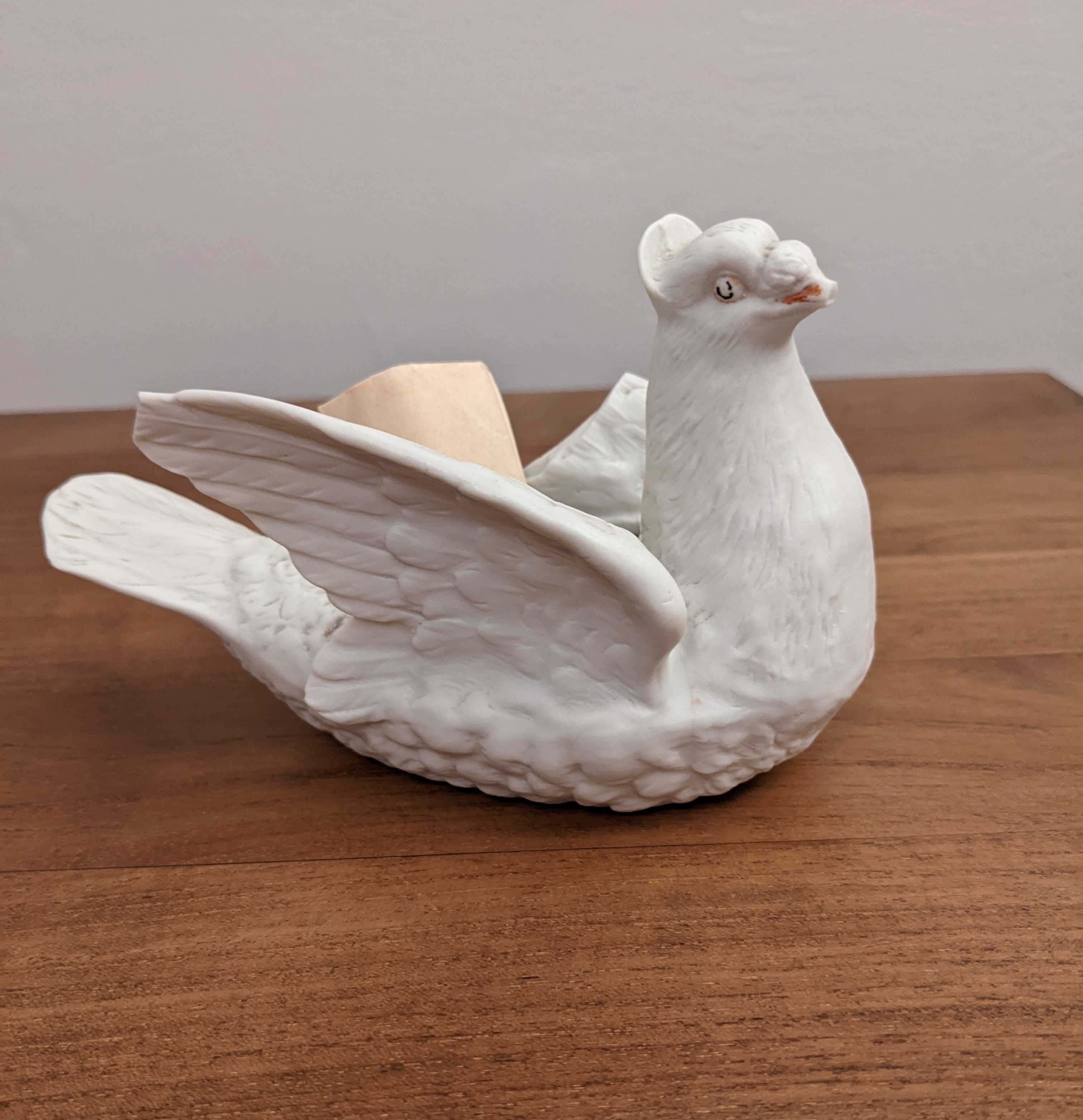
The porcelain dove figurine

nurses a broken wing.

Shaped to hold calling cards or

perhaps small treats

on a dining table,

the gentle vessel reveals

a folded note in my grandmother’s hand…

“My mother’s mother (Kate Faber Remine)

was paralyzed for 10 years —

she died when I was 6 weeks old.

The minister (Reverend Stryker I think)

gave her communion in this one Whitsunday.”

I did not know the good reverend

or my great, great grandmother Kate.

But, history floats down

on the wings of my grandmother’s offering.

Silent Intruder

Seven mallards

on our neighborhood pond

were making an unreasonable racket,

given the early hour.

Paddling furiously across the water’s surface,

the pack squawked and chattered,

a group of unruly school children,

spoiling for a fight.

I hurried to determine the source of irritation,

but stopped short, 

rounding the bend.

Standing in the willowy 

winter husks of pond grass

stood a tall steel blue heron.

Unmistakable

with a smooth white breast

and a long, sharp bill,

the towering heron 

paid the bothered ducks no mind.

Instead, the quiet hunter 

scanned the water

for breakfast.

Arriving at the grasses edge,

the blustering brood 

recognized the futility of the mission.

Sharing the space was THEIR problem,

not the heron’s.

Heads hung, the ducks simply swam

in and out of the grass,

pretending not to care.

Or perhaps the ducks realized

What we all must learn…

Winning is hollow.

To survive,

coexistence is essential.

What Lies Beneath

Early on Thursday

a truck, toting a backhoe

arrived at the small, grey-blue house

to undo the ordinary cement patio.

As a jackhammer did its work, 

jagged slabs of concrete loosened

for the backhoe to scoop up.

Heavy, stagnant,

the concrete did not bend or flex.

Awkwardly, the backhoe coaxed

each piece toward the waiting truck.

Beneath,

the earth took a deep, cleansing breath.

Shaking off the modern mantle,

the ground released woolen threads

from a tartan picnic blanket

that lay on this spot in 1942.

Ripe apples, waxy cheese and iced tea

scented the air

during a rare respite in wartime Washington, D.C.

The next breath

recalls the Union soldiers

who tramped through the light woods

toward nearby Virginia Seminary,

now a hospital for the wounded.

Drawing deep,

the earth protects a shell necklace

dropped 400 years ago

by a noble Algonquian.

Living in harmony 

with mother earth,

the Algonquian understood

we are all visitors here.

A Brother Lost

Hidden among the microfilm reels

in the National Archives

lies the ghost

of a lost brother.

My father’s father, Elia,

set sail from Boulogne-Sur-Mer

aboard the SS Ryndam in 1921,

a small scar on his forehead

his only documented belonging.

Fleeing life in Austria,

Elia’s older brother Samuel

a bookbinder,

paid his passage.

Family lore

follows the brothers west to Denver.

But why Denver?

Why escape the Austrian Empire’s

cold reaches in Kolomyya

for the mountainous west?

Here,

the lost brother floats around the edges.

Elia and Samuel,

stricken with tuberculosis,

took treatments

at the Consumptive Relief Society Hospital

in Lakewood, Colorado.

Here,

the lost brother rises.

Elia and Samuel had

followed breadcrumbs

from an older brother Max,

who first blazed the trail,

before consumption took him

at the tender age of 25.

One insipid illness,

plaguing a generation,

changed the path of my family,

and marked the map of human destiny.

Centered

Early morning walkabouts

provide one unparalleled advantage —

freedom to roam.

Specifically, I wander

into the middle of the street.

On quiet deserted lanes

the middle of the road provides

a wider sky,

a broader vista.

My dogs happily hop the curb

and beeline to the center,

unbound by narrow sidewalks

and carefully manicured lawns.

From the street’s midpoint,

it is easy to view

cherry blossom trees

arching fragrant boughs

as if uncurling after a long nap.

Cresting a hill,

one breathes in

and breathes out,

as the widening expanse calls for pause.

Headlights rounding a corner

in our direction,

receive unjustified indignation

as the pups and I

are forced to return

to constricting conformity.

Next time you venture out,

consider boldly claiming

the entire road,

surveying your kingdom

from the center…

and breathing in,

breathing out.

The Cattleman

New York City, 1970s:

awash in contradictions —

Downtown, 

grit and graffitti lined walls,

pop art and disco

lent a thrumming beat.

Uptown, 

moguls in suits

sent towers of glass and steel

rising in the sky.

At 5 East 54th street,

Larry Ellman’s Cattleman 

stood at the confluence.

A larger-than-life steakhouse,

The Cattleman was part feast, part show.

P.T.Barnum would have been proud.

Broadway filled its booths

alongside businessmen in suits.

In 1977,

my family of five finished 

our chuckwagon meals

then heading outside for

a stagecoach ride.

Yes, a stagecoach.

The Candy apple red coach 

with lemon yellow cushions

sat curbside, complete with 

cowboy-hat clad driver.

You can see the wonder 

in my younger brother’s eyes 

as he listens to the driver 

Prepare us for the journey.

No time machine 

could have been more startling

to his young suburban heart.

Larry Ellman’s Cattleman is no more.

Gone, too, are disco, Andy Warhol,

and any graffiti not sanctioned by the city.

For me, the world is poorer for the loss.

Ever Present

We met for coffee

in the crisp morning hours.

Sitting at an outdoor table,

my friend and I,

both fully vaccinated,

sat a few feet apart

chatting animatedly…

it felt so normal.

At a nearby table,

a woman and her dog were enjoying

the brisk air and rising sun.

Suddenly,

her dog began to howl —

a long, ancient keen

belonging to his ancestors.

An emergency vehicle sailed by,

blinking lights, blaring horns.

The black lab matched

his plaintive howl

to the sirens’ refrain.

“He feels like he needs

to mourn everyone,”

she offered with a light hearted laugh,

until we all realized…

nothing is normal.

Evening Light

The Manitou Island ferry

departs for the mainland

as we stand,

backpacks hoisted on shoulders,

watching from the shore.

The deserted island,

now a national park,

had been a stop for ships

traveling from Canada.

With its deep water harbor,

Manitou offered respite

and wood for ship’s boilers.

But, coal and progress

slowly starved the island of commerce.

Only the ghostly remains of buildings

bathed in evening light

hug the shore,

and a quiet cemetery in the woods

marks the lives

of residents from

a century ago.

Off shore

The wreck of The Three Brothers

lies in the shallows.

Brave souls can dive below

Lake Michigan’s still waters

to gaze at what remains.

A chorus of spring peepers

signal evening’s approach.

The ghosts of Manitou

keep us company

as we make camp for the night

amid glorious evening light.

*poem inspired by Lynn Adams’ Evening Light & Linda Rief

Prey

Gray, downy feathers

drift slowly

toward the ground,

like the first flakes of snow.

High on a branch,

bent with cherry buds,

sits a red-tailed hawk,

resting on the limp remains

of an early morning meal.

Chocolate brown feathers

fold down toward

a cinnamon red tail.

A quick swivel

of the bird’s head

reveals a piercing yellow eye.

Understanding is quick,

prey never has a chance.