Student Slices

lemonmeringuepie

I encouraged my 8th grade students to join me in “slicing” during the month of March. But, late in the school year life can be stressful. I was uncertain if any students would jump on board.

Last Sunday morning, with coffee in hand, I popped into our class blog to see if any students had accepted the challenge. My heart soared when I saw a number of posts from students. Each writer selected beautiful, meaningful images to herald his or her post.  What’s more, the slices were true to the intention of the Slice of Life challenge. Students wrote about moments from the day: a storm, homework, volleyball practice, a doctor’s appointment.

Thanks to a wonderful teacher, Sally Donnelly, we all have SOLSC calendars and I have provided stickers so students can track their participation. Each day more students are joining the writing brigade. Our writing community is knit tighter daily as slice upon slice add up to a delectable pie.

A View from the Student Seats

Professor picking out student for an answer in lecture room

I am currently completing a second graduate degree. As a result, I spend one or more nights a week seeing the world through student eyes.

I feel my students’ pain when assignments pile up or the timeline for task completion is short. What’s more, I cringe when I do not have mentor texts to guide or inspire my work.

I have started to keep a list of reminders when I plan writing assignments. A few of my favorites include:

  • have a set of mentor texts ready to go
  • set up a padlet so students can crowdsource research
  • provide frequent opportunities for students to talk about the work
  • rather than whole graphic organizers (that can sometimes limit student creativity or hamstring writers), offer frames for part of the work (a thesis frame or an opening or closing)
  • create a list of potential student questions and answer them with a FAQ document
  • use exit tickets for students to privately raise concerns or ask for help
  • create resource folders with writing tools (lists of transition words, writing checklists)

Writing is hard. As a student, I stay up late working on  papers. I am thankful for each and every tool my teachers provide to help me produce my best work.

slice of life logo

On Being An Optimist

optimism

This week, my students are drafting speeches about optimism. It can be tough to be optimistic in a world riddled with bullets and mired in unkind speech. In honor of my students, I crafted a brief poem:

Optimism

A finely sharpened pencil scratches

the surface of the white page,

Yes. I can.

Words on the tip of the tongue

begin to tumble in a rush.

Yes. I will.

A phone rings in the dark of night

as an ear attaches to the receiver.

Yes. Of course.

Optimism does not rest in the belief

But in the willingness.


Jazz: Blues Alley

Blues_alley

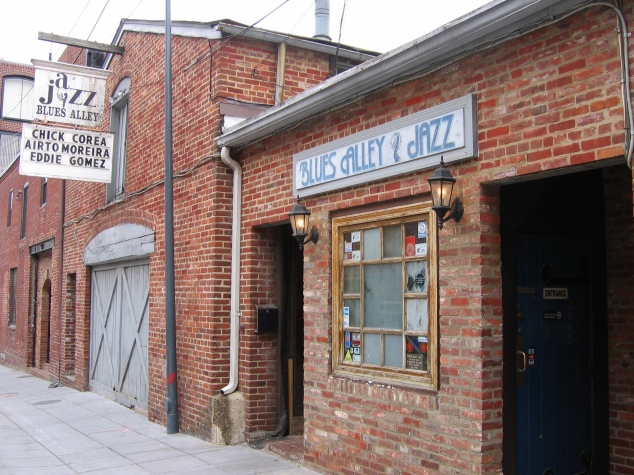
Friday night my husband I headed into Washington, D.C.’s Georgetown neighborhood for an evening of jazz. Georgetown has been home to Thomas Jefferson, John F. Kennedy, Katharine Graham, Julia Child, Elizabeth Taylor and Bob Woodward. Georgetown is also home to the renowned Blues Alley jazz club.

Blues Alley sits in a true alleyway just off the main thoroughfare in Georgetown. If you have never visited Georgetown, the community is incredibly picturesque. Colonial buildings mix with brick row houses that sprung up after the civil war. The C&O Canal flows through Georgetown and residents walk the towpath on warm days.

Entering Blues Alley feels like walking into a secret cave. The sound of conversation, laughter and clinking glasses draws you in. This is the place to be. Patrons are sandwiched in around small tables as waiters weave back and forth taking food and drink orders. The Cajun fare is good, bringing back memories of visits to my husband’s home state of Louisiana.

As the lights dim further, the crowd hushes. Several unassuming individuals make their way up onto the barely raised stage. Patrons sit right next to the drums, bass and piano. Everything about Blues Alley feels intimate.

Years ago, my husband remembers seeing Dizzy Gillespie in the small venue. Players wait in a modest lounge upstairs at Blues Alley. The room is open and not far from the restrooms. There sat Dizzy Gillespie warming up, puffing out his cheeks in preparation for the show.

In my experience, jazz musicians are warm, appreciative people. I know that is a generalization but at Blues Alley, the musicians often head to the bar for a glass of water or something stronger at set’s end, and they kindly greet patrons giddy with compliments. Jazz musicians are a rare breed. They seem to travel constantly from club to club. At each show I’ve attended the commitment to the music is evident. Improvisations flow and the musicians create a new journey each time.

When we left Blues Alley on Friday night, I carried a club calendar with several upcoming dates circled. Jazz is magic in a bottle and I can’t wait to hear more.


The Night the Lights Went Out

keep-light-power-outage

We felt lucky not to lose our power on the first day of the Washington wind storm. However, on the second night of the wind event, our power flickered several times and then extinguished. My husband, two dogs and I sat on the couch in the kitchen and peered out at our neighborhood.

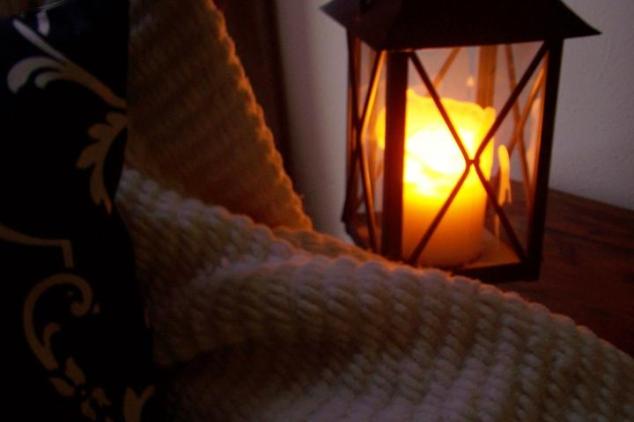
Our house sits on a hill so we have a view of several streets. Darkness enveloped the whole neighborhood. We watched as a few flashlights and lanterns went on in nearby houses. We, too, had brought lanterns into the kitchen when the lights started to flicker.

There is something so cozy about sitting in a darkened house with loved ones. The lanterns give off a soft glow as we shuffle around the kitchen working on peanut butter sandwiches for dinner. What’s more, power outages always make me feel we are somehow closer to our neighbors. We are all in it together.

Several years ago, I read a wonderful book by Barbara Brown Taylor entitled Learning to Walk in the Dark. The book explores our relationship with darkness. Taylor notes that the invention of artificial light changed us forever. We can alter night with a flood of light. Our sleep cycles have been disrupted by the glow of constant lights. The stars are no longer visible everywhere. But, one of the things that struck me most in the book was her talk about our association of darkness with danger and evil.

There are many beautiful things found in the dark. A late night walk in my neighborhood might flush out a fox or raccoon. As a child, I loved the sound of the crickets and spring peepers outside my grandparent’s back porch. Laying in the grass looking up at the stars on a summer night in Maine is breathtaking. And, don’t forget the glory of the first fireflies in summer.

On this night, I am thankful for the respite from manmade light. I love the glow of a candle and the quiet night sounds. I tuck my legs under me as I open a good book and settle in.

A Blustery Day

120701122115-dc-storm-05-horizontal-large-gallery

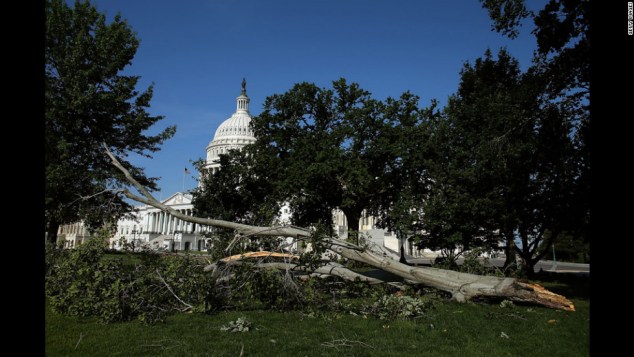
Washington, D.C. was hit by a powerful windstorm this weekend. The federal government and area schools closed for the day on Friday. Social media overflowed with comments about how wimpy Washingtonians are when it comes to weather. It is only wind for goodness sake.

However, the wind that howled and whipped and tore tree trunks straight from the ground was anything but wimpy. All day we have listened to the wind roar. At times it felt as if the roof might leave the house. The sound of cracking tree limbs scored the air. We watched as our neighbor’s adjoining fence fell into their yard, leaving a gaping space between our previously separate yards.

When it was time to take my dogs for a brief walk, a neighbor cautioned I should walk in the middle of the street to avoid any falling tree branches. Yes, Washingtonians tend to overreact when it comes to weather. After spending several winters in the Midwest, I am often surprised by how quickly things shut down in Washington at the mention of snow. But, this Friday the caution was warranted. Safety comes first.


Thursday Morning: 5:45 am


IMG_0869

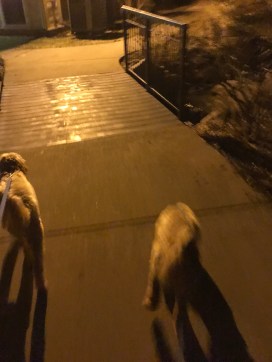
It is quiet and dark as the dogs and I pad out the door at 5:45 in the morning. The air does not hold the biting chill of a winter morning, perhaps spring is closer than I realize. Light from street lamps pools in small circles as I look down Trinity Drive. A few birds are just waking in the last cover of darkness. Every scurry in the branches startles Georgia slightly as she charges down the sidewalk.

My puppies have very different personalities. Georgia is soft and gentle around the edges. Her deep chocolate eyes peer up through long, thick lashes. She is girlie on the outside, but her independent streak regularly rises to the surface.  For instance, after a minute of snuggling, Georgia will head to the other end of a couch to settle herself. She dictates the interaction. On walks, Georgia often leads the way. Head resolutely forward, Georgia forges ahead as if she is late for an appointment.

Max, on the other hand, takes his time in the morning. He stops to smell his surroundings, sure he will miss out if he moves too quickly. Max is smaller than Georgia by a couple of pounds, which is important if you only weigh 20 pounds. However, Max acts larger than his sister when strangers are near. On the inside, Max is gentle and respectful. His kindness to his sister is reassuring.

Our morning walk is peaceful in the dark. Down the street and around a corner we trot on our way to a small man-made pond. Four ducks cut across the still surface of the water as they feed. We do not have long to tarry at the pond, Georgia has things to do and places to go. A warm glow on the lip of the horizon reminds me that I have places to go as well..

Giving Students Choice: Journals

IMG_2569

On Tuesday, I received an express delivery from UPS. Inside the small package, three crisp notebooks from one of my favorite sources — May Designs — sat wrapped in tissue paper (You can see one of the small journals in the bottom right of the photo above). One of the notebooks is my new summer journal!

During the school year, I carry a sturdy Leuchttrum1917 journal with fabric bookmarks and dot grid pages.  A shelf in my reading room at home holds an array of brightly colored journals from the past few years. This may seem like a lot of information and care for a disposable journal but my journal goes everywhere with me. Inside, I write teaching ideas, inspirations, snippets of a YA novel in progress and a daily “to do” log.

For summer, I opted for a smaller, light weight journal that can fit in a beach or travel bag. While setting up my journal this morning, my thoughts drifted to September and the writing journals my 8th grade students will set up.

Writing journals play a pivotal role during the year and the school supply list always includes a standard composition book. Personally, I set up a composition book to write when my students are writing — the notebook is a quick model in the classroom.

If I am honest, the English class writing notebook has its ups and downs.  The year starts with a bang. Students decorate, jot notes, write drafts and draw in their notebooks. In the midst of writing workshop, students go everywhere with their notebooks. For some students, the notebook remains an integral part of their writing identity all year. However for others, the writing journal is just another thing they must try to remember to bring to class. In fact, there are a few students who do most of their drafting during the year on loose paper because they always forget their notebook at home.

Looking at my new summer journal (with a lovely abstract painting in blues and greens), I wonder if the issue begins when the supply list goes home? Students dutifully arrive with a generic composition notebook that they then spend time trying to personalize. What if choice were part of the early equation?

This year, I will have an array of journals on hand for students. I will:

  • pick up a stack of composition notebooks on sale at Staples (some students love them)
  • search the sale shelves at Michael’s/AC Moore/Target
  • grab a handful of journals at Ikea
  • donate a few of the blank journals I have on my shelves 🙂

With options in hand, I will give students choice. Since I teach 100+ students, some students will need to supply their own journal. However, I believe the search for “just the right journal” will increase the journal’s importance for many students.

This past year, one student carried a small black leather journal. The notebook went everywhere with him. A strong artist, he drew, wrote comic pages and journaled for class in the notebook. When it was time for David to turn in his notebook so I could read drafts, I always collected his notebook in class and returned it before the end of the day. I did not want David to be long without his journal.

When introducing the writing journal next year, I will spend time talking about the importance of a place to write. Students will see pages from famous writer notebooks and hear the voices of writers they love talking about notebooks. From the start, the writing notebook will be personal!

Hopefully, a small investment in time and dollars this summer will lead to a new practice in classroom journal design. As I head out the door with my indispensable journal, I have high hopes for the coming year.


Building Reading Excitement — Kwame Alexander Has the Right Idea

IMG_2551 2

A few weeks ago I received a link to sign up for Kwame Alexander’s Solo launch team. My students and I ADORE Kwame’s books and I crossed my fingers that I would be one of the 400 chosen to receive an ARC of the book.

Lucky me! I got an email last week that the book was on the way and all I had to do was share the book and promote Solo across my social media platforms. Both of the tasks Blink YA books asked for are a natural part of book love for me.

Excitement built as I waited for the book to arrive. On the Solo Launch Facebook page, people were starting to share joyful pictures of the book’s arrival. I found myself rushing home in the afternoons in search of my neighborhood UPS truck or a package on the doorstep. I chatted online with other Solo launch teachers about the book and other Kwame books.

Yesterday afternoon the book arrived. I tore open the package and fanned through the pages. It felt like my birthday and summer vacation rolled into one. My husband and son could now stop listening to me talk about the book and Kwame 🙂

Kwame and Blink YA did a wonderful job building excitement for the new release. Across the country, 400 teachers/book lovers with healthy social media presences were busy talking up the August release.

The launch got me thinking about how we build this level of excitement for our student readers. Mock Newburys, Battle of the Books, The Global Read Aloud and other community book projects have the right idea. In addition, to book talking, we need to give students a chance to anticipate a great read.

This year I taught sixth grade English and during one of our novel units, students were given the choice of 40 historical fiction titles. Our middle school has 450 sixth graders so we did not have an endless supply of every title. After a week of book talking and speed dating books, students filled out a Google form with their top 4 choices. A lot great conversations happened during that week — students recommended books to other students, friends picking a title or two they wanted to read together and more.

One of my most reluctant readers decided Gary Paulsen’s Woods Runner was the only book he wanted to read. We had 30 copies for the whole grade and it was a popular choice. I heard this student talk about the book in the halls and he asked several times when the “winners” would be announced.

“I won?!” he marveled as I handed him the new copy of Gary Paulsen’s fast-paced historical fiction tale. “I never win,” he added. He sat down in the reading corner and immediately opened the cover.

That book changed the student’s reading year. He regularly asked for new titles and talked about books with his friends.  Action-packed historical fiction,  graphic novels and mysteries were his favorite. He did not want particularly long books but he grew confident in articulating what he looked for in a book.

Winning is a good feeling. When I was chosen for the Solo book launch my strong interest in the new release turned into tangible anticipation. “Winning” a copy of a limited novel for a novel unit opened the door to reading for one student.

Next year I plan to be more intentional in building anticipation for books. I will launch book clubs, incorporate more student voice in classroom library purchases and talk up new titles before they arrive to build excitement for reading. I will talk to my students about larger community reading projects to spark interest.

My hope for next year is each of my 8th grade students will feel as lucky as I did yesterday when the bright read cover of Kwame Alexander’s Solo slipped out of the UPS package.

Real World Mentor Texts

IMG_2549On Sunday mornings, my favorite thing to do is sip coffee on the porch while reading The New York Times (NYT) and The Washington Post. This weekend ritual is especially sweet in the summer months because there is no rush to get on to a long list of chores.

This summer my weekend reading has another purpose: finding real world mentor texts for my 8th grade students. Next year I am moving up from 6th grade to 8th grade English. One perk of this switch is a broader choice of topics and a deeper level of sophistication for reading.

With the 2016-2017 school year complete, I find myself looking to fill my teaching toolbox with mentor texts that will speak to older students. Fortunately, interesting mentor texts are all around.

In this Sunday’s papers I found several worthy examples:

  • a NYT SportsSunday front page story entitled, “Soccer’s Art of Calculating a Player’s Worth.” In the midst of the player transfer window, the NYT breaks down what the dollars mean. This article is great for soccer fans but could be paired with an article about trades in hockey and basketball going on now or an article about the famous Alex Rodriguez baseball contract that changed pricing in baseball.  In addition, I can hand this article to a student reading Kwame Alexander’s Booked.
  • a timeline of the 2016 U.S. election and new revelations. Today’s heated political environment is put in the context of revelations and their timing. What I like about this article is the format. The authors are able to distill a great deal of information into short sentences laid out on a timeline.
  • “36 Hours in Dubrovnik, Croatia” in the NYT travel section. Author and teacher Kelly Gallagher first turned me on to the value of these page-long articles. Each week the NYT offers a 36 hour guide to some location. I collect the articles and ask students to consider location selection, theme and what is most striking in the article. In the past my students have written their own “36 Hours in…” and comparing a few selections from the NYT is particularly valuable.
  • Another find in the NYT travel section is the “Surfacing” column. This regular series offers readers five places to go in some city around the world.  The series differs from “36 Hours in…” because the articles tend to be more thematic. This week features “Low-key Options for Nighthawks in Logan Square,” a location in Chicago where my son happens to live. My son is a night owl and Chicago is a favorite city for me so I immediately found the value in the theme.
  • “Why I Resigned from the Foreign Service after 27 Years” by David Rank in The Washington Post is found on the opinion editorial page. In the article, Rank, America’s senior diplomat in China, lays out his reasoning for leaving now. First, Rank describes his wealth of experience, his proud non-partisan stand, his close calls with danger as well as missed family moments. After the first few paragraphs, Mr. Rank is well positioned to state his concerns for America’s future. This article would be useful in a class discussion about what makes a strong position piece because it definitely has pluses and minuses.

These are just a few of the examples I found in two newspapers on a Sunday morning. Each day can bring new mentor texts if we just read with an eye toward writing.

On Sundays, we receive a weekly Blue Apron box that makes some week nights easier. the box includes recipes and all the precise ingredients to make quick meals. A few weeks ago, the box included a full color booklet entitled, “The Secret Story of Soil.” Filled with beautiful pictures this booklet included charts, a glossary and an article featuring a small farmer in northern California. As a former public affairs executive, I recognize the pamphlet as a clever marketing tool aimed at connecting the Blue Apron box with the local farm stand. However, as a teacher I find this piece of non-fiction writing illuminating. Other booklets have included “The Power of Pollination” about bees, “The Fight to Save Salmon” and “The Wide World of Wheat.”  My Blue Apron box has become a source of highly focused, non-fiction mentor texts! Students can look at content, source and reliability.

I am excited to see what other mentor texts pop up over the summer. If you have any go-to spots for real world mentor texts, please share your ideas in the comment section.