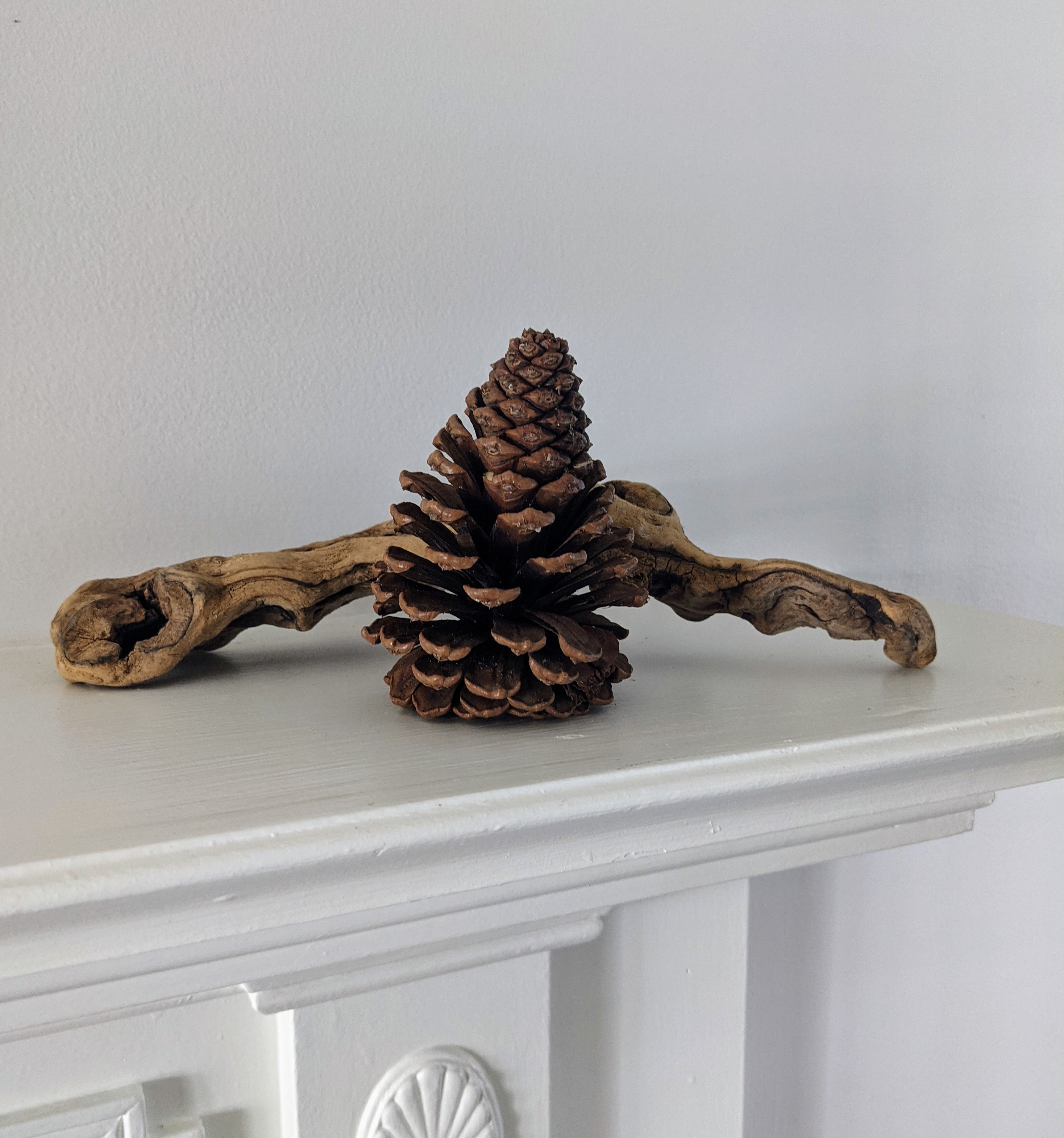
Pine Cone

As a child I collected treasure on walks —

sea glass, acorns, driftwood, shells.

My mother honored my discoveries by creating

small tableaus throughout the house —

a woodland scene on the mantle,

a beach scattering on the kitchen counter.

Today on my walk

I found a large pine cone

nestled in a bed of pine needles.

Even though my hands were full,

two rambunctious pups on leashes,

I stopped to scoop up this find

and carry it two miles home.

Pine cones have one primary job —

encase pine tree seeds

in a fortress of woody leaves to protect

them from winter and wild animals.

It takes nearly three years for a pine cone to mature.

Yet, once the pine cone falls,

it opens its stiff scales,

allowing the gentle seeds to move on.

My abandoned pine cone, a parent and vessel,

now sits on the mantle so we can honor

its role in replenishing the earth.
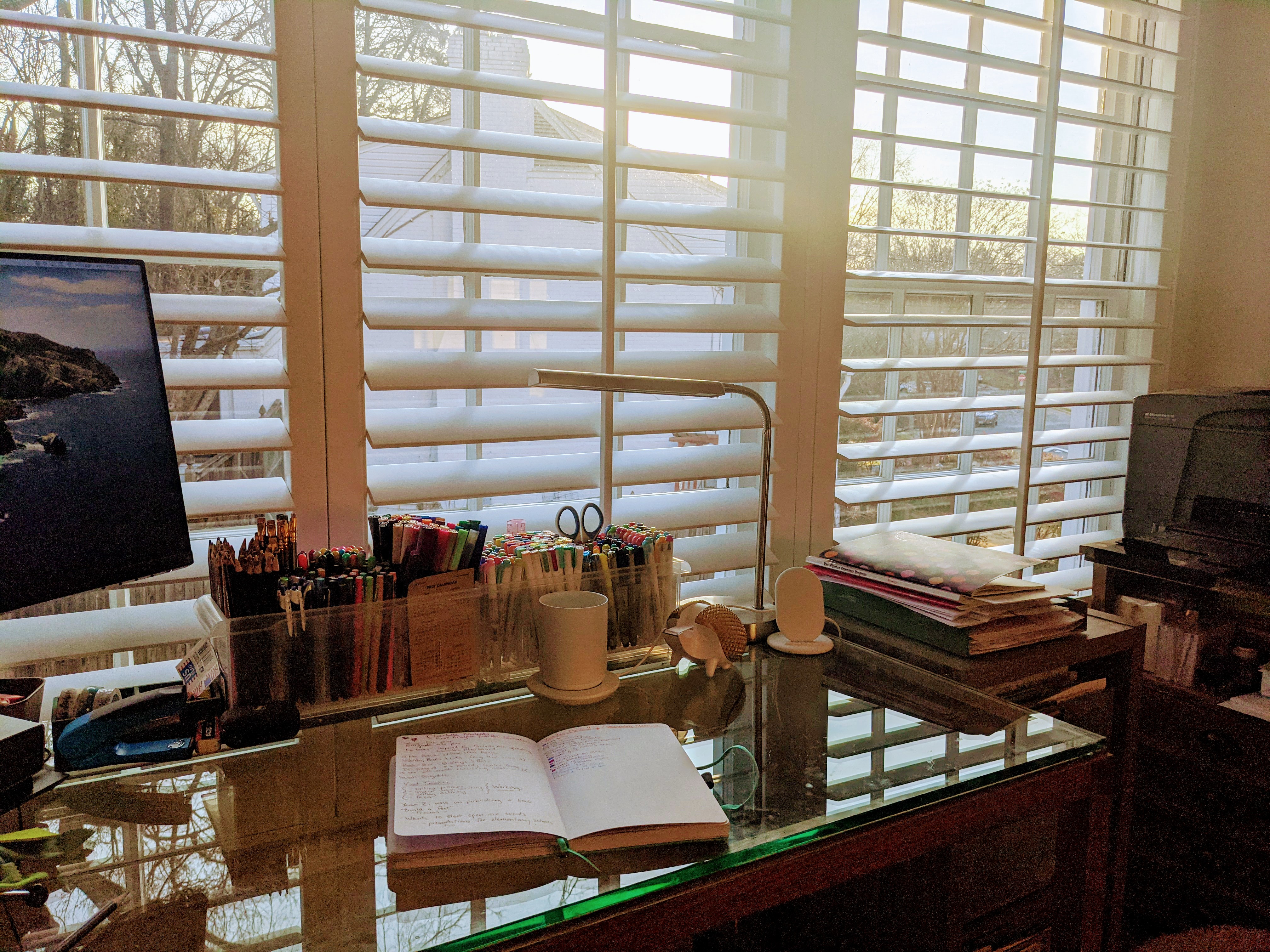
The Comforts of Home

If quarantine has taught me anything,

it is the pleasure of small things.

There is an order to the day,

absent when schedules are rushed.

A pot of Love Supreme coffee from Chicago,

Art Pepper’s jazz warming the room,

two pups asleep on the plush rug at my feet.

Outside the tangerine sunrise

melts into the horizon.

My desk by the window holds all I need —

pens, extra sharp pencils, an open journal.

A year ago, this comfort was only possible

on Sunday mornings.

But now, I rise at 5 am for a long walk —

dogs, birds and neighborhood foxes in tow.

I will miss the solitude, the order, the peace of mind

when the world reopens fully.

For now, I sip my coffee

and appreciate the comforts of home.

Silence

When we waver,

it is often done in silence.

Silence offers the mind space to regret,

mourn, ponder, reflect.

Silence speaks as loudly

as the truth.

Silence can be a canyon

filled with the noise

of a thousand minds speaking, yet unheard.

But…

silence can also be bliss.

Silence can be a reward

at the end of a day filled with sound.

Silence can be savored,

cherished, appreciated.

Silence is never nothing.

*This poem was inspired by Krysten Hill’s poem “Nothing”.

Photo by Andy Køgl on Unsplash

What Lies Beneath

When the tide is low

the center of the meandering river

reveals small islands of lush green grass.

How this grass took root,

in such a tenuous spot,

is a wonder.

The water constantly moving

buffets the sturdy tufts.

But,

when the sky clouds and the rain descends,

the gentle islands of grass

submerge.

Rushing liquid pours over the grass,

causing a slight disturbance

in the river’s flow.

Had I not seen the majestic stalks waving

in the low tide,

I would not hold

the delicious secret I have now.

Hidden below the shimmering surface

lies an oasis,

a verdant respite

from the world’s turmoil.

If only the brave reeds can withstand

the urgent march of changing times.

Memory is a Funny Thing

Scientists tell us

sixty percent of adult memories

come from the time between 15 and 25 years.

The “reminiscence bump” stores

early adolescence and young adulthood

to revisit on cold winter nights

or with the familiar scent of the first spring rain.

What of the other 40% of memory?

The sweeping snowy owl

flying low past our car on a long ago night;

paddling the quiet waterways of the Pine Barrens

in a dark green canoe;

badminton at a sparkling fourth of July picnic;

or an Easter egg hunt on a plush green expanse.

Snatches of memory from early childhood

bubble up unannounced,

bright and vivid —

as if fighting to remain.

What Do Our Hands Reveal?

For years, I have carried a few lines from Martin Luther King, Jr.’s “Letter From a Birmingham Jail” in my heart. He wrote, “On sweltering summer days and crisp autumn mornings, I have looked at the South’s beautiful churches with their lofty spires pointing heavenward. I have beheld the impressive outlines of her massive religious education buildings. Over and over I have found myself asking, ‘What kind of people worship here? Who is their God? Where were their voices when the lips of Governor Barnett dripped with words of interposition and nullification? Where were they when Governor Wallace gave a clarion call for defiance and hatred?'”

For too long we have disregarded

the hands that write the oppressive, racist laws;

the hands that sit idly folded in laps;

the hands that toiled to build places of privilege

but were excluded from those very places.

Each year, I have my students trace their hands for one or more writing activities. Sometimes they fill the tracing with the names of things they hold dear. Other times, students fill the open hand with memories. Our hands are important. They are symbols. Hands say a lot about who we are — long nails or bitten nails? Callused or smooth hands? Open palms or clenched fists?

When I reflect on what my hands have wrought, I find a mixed bag. I remember times I allowed my hands to remain idle when they should have held up signs in solidarity. Conversely, I recall times I used my hands for good, for equality, for justice. If I traced my open hand right now, some of the elements I could add shine bright while others call out for redress.

In the quiet of an early Saturday morning, I know my hands have much work left to do.

Optimism

The man stepped outside

ill equipped for the weather.

He wore a knee-length plaid bathrobe

and leather bedroom slippers.

His pale bare legs were

a shocking white against his home’s green lawn.

As he walked down the short driveway

to retrieve the daily newspaper,

I said to myself,

“This guy is nuts!”

Bundled in a knee length down jacket,

hat, gloves and a neck warmer,

I silently congratulated myself

for checking the below freezing temperature before heading out.

My dogs wagged their tails

in the predawn chill,

hoping for a hello from the older gentleman.

“Fine morning! ” he exclaimed.

“Pretty cold,” I responded.

“Brisk! Best way to start the day,”

he added as he turned to head back inside.

Walking toward home, I wondered…

is it possible to be too prepared?

Too cocooned?

Weighing down our pockets

to prepare for any possibility,

are we missing the chance

for a brisk start,

a new experience,

an unaccounted for outcome?

Visions of Spring

“Stop the car!”

My father,

slamming on the brakes,

at my mother’s exhortation,

sent we three young children

forward into the heavy padding

of our Country Squire station wagon’s front seat.

I do not remember how upset my father was at the outburst

or how long it took to shake off the startling stop.

What I remember vividly is my mother’s face

beaming as she rolled down the window

and peered into a neighbor’s front yard.

There,

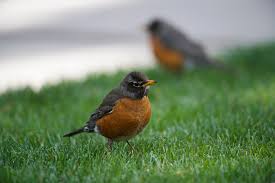
a flock of robins

bobbed up and down,

their red breasts jutting out as they righted themselves

between stabs at the thawing lawn,

all in search of seed.

Robins, a harbinger of spring,

still pull me up short

when I spy

the flash of a red breast

or hear the robin’s song

quilt the air on an early spring morning.

Three Kinds of Rain

As I open the door,

it is not instantly obvious

there is rain.

A fine mist brushes my cheek

and I raise the hood on my jacket.

The dogs lift their noses to the sky,

puzzled by the whisper of moisture.

Enough rain to glaze the leaves,

but too little to keep us indoors.

A heavy rain, on the other hand,

is another matter…

calling for a screened in porch, a cup of tea

and some company to listen to

the rain beat a steady rhythm on the roof.

A downpour is even better

when accompanied by the rumble of thunder.

The porch is both inside and out — comfort in a storm.

But,

it is the summer rain that evokes a deep breath.

Summer rains are warm, soft and welcoming.

After a summer rain,

the fertile ground releases scents

of rich soil, lilac and freshly mown grass.

Summer rain brings life

as the world around us

blooms from the generosity of clouds.

Ordinary

Routines

ground us.

To do lists, calendars,

busy agendas —

these are the foundation stones

of our society.

Yet…

when the calendar

is empty

and the tasks become

ordinary,

there is a calmness

that descentds

Birds and breezes

are suddenly more apparent.

The shade of trees,

the scent of flowers,

become gifts.

Sleepless nights still abound

as worry keeps eyes open,

but there is peace too

when we are untethered.

** inspired by Allison Joseph’s “Untethered”.